Lekhan Kala
Kathmandu, 18 May 2026
International development partners supporting Nepal’s education sector reaffirmed their firm commitment to collaborating with the Government of Nepal to improve learning outcomes for all students and strengthen the school education system.
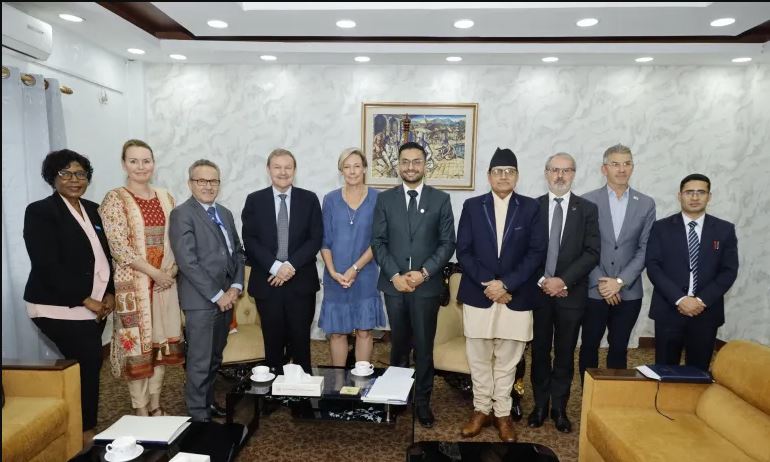
During the School Education Sector Plan (SESP) Budget Review Meeting and a high-level discussion with the Minister for Education and Sports, Mr. Sasmit Pokharel, participants expressed this commitment.
The meeting brought together government officials and development partners to review progress and discuss priorities for the future of education in Nepal.
The School Education Sector Plan is the government’s flagship program for school education, implemented through a Sector Wide Approach (SWAp).
This approach encourages collaborative engagement among government institutions, development partners, and other stakeholders, setting it apart from traditional top-down models.
Its primary features include promoting access to quality education, advancing inclusion, and enhancing Nepal’s education system’s resilience through joint planning and collective accountability.
The Joint Financing Partners (JFPs)—including the European Union (EU), Foreign, Commonwealth and Development Office (FCDO), Embassy of Finland, Royal Norwegian Embassy, UNICEF, Asian Development Bank (ADB), and the World Bank—praised the Government of Nepal for consistently practicing transparent, evidence-based planning and strong collaboration in the education sector.
During the review meeting, participants stressed that improving foundational learning among children remains Nepal’s most urgent educational challenge.
They acknowledged progress in expanding access and inclusion, but called for greater efforts to ensure every student gains essential literacy, numeracy, and life skills for the future.
The development partners welcomed the government’s decision to increase education spending to 11.11 percent of the national budget.
They stressed that investing in education is vital for developing human capital and creating better opportunities for Nepal’s children and youth.
Partners also appreciated the Ministry of Education and Sports’ support for all 753 local governments in preparing and approving local education plans.
This initiative aims to strengthen decentralized planning and ensure more equitable and evidence-based educational development across the country.
Another important topic of discussion focused on the School Education Bill. Development partners welcomed the government’s commitment to resubmit the bill to Parliament within the current fiscal year and recognized its importance in providing a stronger legal foundation for education reform and in effectively implementing federal education policies.
The meeting also urged accelerating student learning by improving classroom teaching practices, enhancing teacher support, advancing assessment systems, launching remedial learning programs, and leveraging data for decision-making.
Participants underscored the need to build institutional capacity at federal, provincial, and local levels so reforms deliver meaningful improvements in learning outcomes.
Recognizing Nepal’s School Education Sector Plan as a leading model of government-led coordination, the Joint Financing Partners pledged to intensify support for reforms that advance quality, equity, inclusion, and resilience throughout the education system.
The partners further stressed the need to prepare children and youth for a rapidly changing, digital world, calling for investment in foundational learning, critical thinking, adaptability, and digital skills as essential to Nepal’s future.
The Joint Financing Partners expressed appreciation to the Ministry of Education and Sports, the Center for Education and Human Resource Development (CEHRD), provincial and local governments, teachers, and all stakeholders for their continued efforts to advance quality education for every child in Nepal.