

 Dhruba Prasad Ghimire
Share Your Story with the World
Every story begins with an idea—a memory, a dream, an experience, or a question to explore. Story writing is a powerful way to express thoughts, emotions, and imagination while connecting with readers across cultures and generations.
For thousands of years, people have shared stories to entertain, educate, preserve traditions, and inspire change. From ancient folktales and legends to modern novels and digital storytelling, stories help us understand ourselves and the world.
At LekhanKala, we believe everyone has a unique voice and a story worth sharing. Whether you write short stories, personal narratives, fantasy adventures, social fiction, memoirs, children’s stories, or literary works, storytelling offers a chance to express creativity and inspire others.
Our platform welcomes write Our platform welcomes writers of all ages and backgrounds. We encourage new and experienced writers to develop skills, share work, and join a growing community of storytellers.
Story writing is the art of creating narratives that describe characters, events, and experiences within a setting. Stories may be fictional, based on real experiences, or both.
A well-written story captures attention, builds emotional connections, and communicates meaningful ideas. Stories entertain readers, teach lessons, raise awareness, or encourage reflection. Story writing involves transforming ideas into narratives that engage readers from beginning to end.
Why Story Writing Matters
Story writing offers many personal, educational, and social benefits.
Encourages Creativity
Stories, in all their forms, let writers imagine new worlds, develop original ideas, and explore different perspectives.
Communication Skills
Writing stories helps organize thoughts, structure information, and express ideas clearly.
Develops Critical Thinking
Creating plots and solving character problems strengthen analytical and problem-solving abilities.
Builds Confidence
Completing and sharing stories increases self-confidence and encourages self-expression.
Preserves Experiences and Culture
Stories help communities
Stories help communities preserve traditions, values, and history. Stories can motivate people, encourage empathy, and create positive social change.
The History of Storytelling
Storytelling is one of humanity’s oldest traditions. Long before written language, people shared stories orally through songs, performances, and spoken narratives.
Ancient civilizations used stories to explain natural events, teach moral lessons, and preserve cultural knowledge. Over time, storytelling evolved via books, newspapers, radio, film, television, and digital media.
Today, storytelling continues through blogs, podcasts, social media, videos, and online platforms. While technology has changed, storytelling’s purpose remains the same: connecting people through shared experiences and ideas.
Types of Stories
Writers can explore many storytelling forms.
Short Stories
Brief narratives focused on a single theme, event, or conflict.
Personal Narratives
Stories based on real-life experiences and personal reflections.
Memoirs
Narratives focusing on specific periods or events in a person’s life.
Fantasy Stories
Stories featuring magical worlds, creatures, and supernatural events.
Science Fiction
Stories exploring future technologies, space exploration, and scientific possibilities.
Historical Fiction
Stories set in the past that combine historical settings with fictional characters.
Mystery Stories
Narratives involving puzzles, investigations, and suspense.
Adventure Stories
Stories centered on exciting journeys and challenges.
Children’s Stories
Age-appropriate stories designed to entertain and educate young readers.
Social and Realistic Fiction
Stories that explore real-world issues and everyday experiences.
Essential Elements of a Story
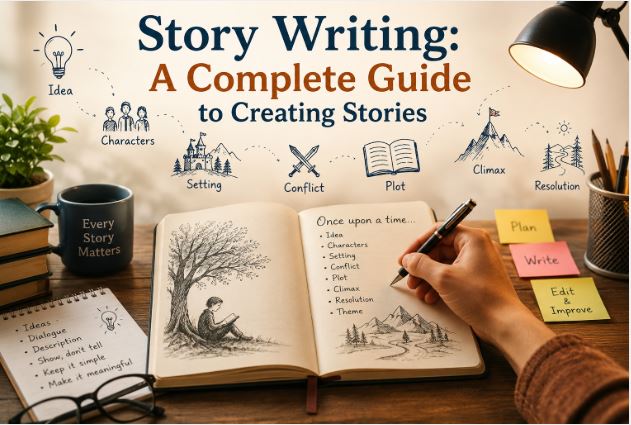
Characters
Characters are the people, animals, or beings in the story. Strong characters make readers emotionally invested in the narrative.
Setting
The setting describes where and when the story takes place. It helps readers visualize the environment and grasp the context.
The plot is the sequence of events moving the story forward.
Conflict
Conflict introduces challenges and obstacles characters must overcome.
The climax is the most exciting and important moment of the story.
Resolution
The resolution concludes the story and answers remaining questions.
Theme
The theme is the central message or lesson in the narrative.
What Makes a Good Story?
Successful stories often share key characteristics:
* Interesting and believable characters
* A clear conflict or challenge
* An engaging beginning
* A well-structured plot
* Realistic dialogue
* Emotional depth
* A meaningful ending
* A clear theme or message
Readers remember stories that make them think, feel, and connect with characters.
To Start Writing a Story
Step 1: Find an Idea
Ideas come from:
* Personal experiences
* Dreams
* News events
* Historical events
* Books
* Nature
* Conversations
* Imagination
Step 2: Create a Main Character
Develop your character:
* Personality
* Goals
* Strengths
* Weaknesses
* Background
Step 3: Choose a Setting
Choose where and when your story takes place.
Step 4: Introduce a Problem
Every story needs a challenge motivating the characters to act.
Step 5: Build Suspense
Create events that gradually increase tension and excitement.
Step 6: Reach the Climax
Create a turning point where major conflicts occur.
Step 7: End Meaningfully
Provide closure and reinforce the story’s message.
Step 8: Revise and Edit
Check grammar, spelling, clarity, and structure before sharing your work.
Example of a Simple Story Structure
Beginning
Maya discovers Maya finds an old letter hidden in her grandmother’s attic. The letter leads her on a journey to uncover a forgotten family secret.
Climax
She finally learns the truth about her family’s past.
Ending
Maya shares her discovery with relatives and helps preserve an important family tale.
Story Writing Tips
* Read regularly.
* Write consistently.
* Keep a notebook for ideas.
* Listen to feedback.
* Experiment with different genres.
* Revise multiple drafts.
* Focus on showing, not telling.
Great writers improve through practice and persistence.
Common Story Writing Mistakes
Avoid these common mistakes:
* Weak or confusing plots
* Too many characters
* Lack of conflict
* Unrealistic dialogue
* Poor pacing
* Rushed endings
* Excessive description
* Failure to proofread
Learning from mistakes helps writers improve.
Story Writing Prompts
Need inspiration? Try one of these prompts:
1. A student finds a mysterious notebook in the school library.
2. A village receives a letter from the future.
3. A child discovers a hidden room in an old house.
4. Two friends uncover a long-forgotten secret.
5. An ordinary day suddenly changes everything.
6. A family heirloom reveals an unexpected story.
7. A traveler gets lost in a place that doesn’t appear on maps.
8. A pet begins behaving strangely after a storm.
9. A community comes together during a difficult challenge.
10. A photograph reveals a mystery from the past.
How Story Writing Helps Students
Story writing helps students to:
* Improve creativity
* Strengthen vocabulary
* Develop communication skills
* Build confidence
* Enhance critical thinking
* Improve problem-solving abilities
* Encourage imagination
* Foster empathy and understanding
These skills are valuable in education, careers, and daily life. Your Story with LekhanKala
Have a story to tell? LekhanKala welcomes original short stories, personal narratives, memoirs, fantasy, science fiction, children’s stories, social fiction, and other creative works.
Prepare your manuscript following our submission guidelines and submit your work through our online platform. Your story could inspire readers, spark new ideas, and contribute to a growing community of writers.
Every great writer begins with one story. Start writing today and share your voice with the world.
References and Further Reading
1. Purdue Online Writing Lab (OWL)
2. National Novel Writing Month (NaNoWriMo)
3. Writers Write – Writing Resources
4. BBC Maestro – Writing Resources
5. Reuters Journalistic Standards Handbook
6. Reuters Fact Check – Methodology and Standards
7. Reuters Handbook of Journalism (MERLOT Educational Resource)
8. Reuters Handbook of Journalism – Google Books
9. Reuters Standards, Values and Ethics
10. Lekhankala.org Story Writing Guidelines
