

 Dhruba Prasad Ghimire
Introduction
The internet has fundamentally transformed the ways in which individuals access information, communicate, learn, and conduct business. Billions of users search the web daily for answers to questions, educational resources, news, products, and services.
Search engines are central to this digital experience, functioning as essential tools for locating relevant information within the vast expanse of online content.
Search engines serve as critical gateways to knowledge. Students conducting research, journalists gathering information, and business owners seeking customers all depend on search engines to access relevant information.
While many search engines have been developed, only a few have achieved significant global influence. These leading platforms continually advance their technology to deliver faster, more accurate, and increasingly personalized search results.
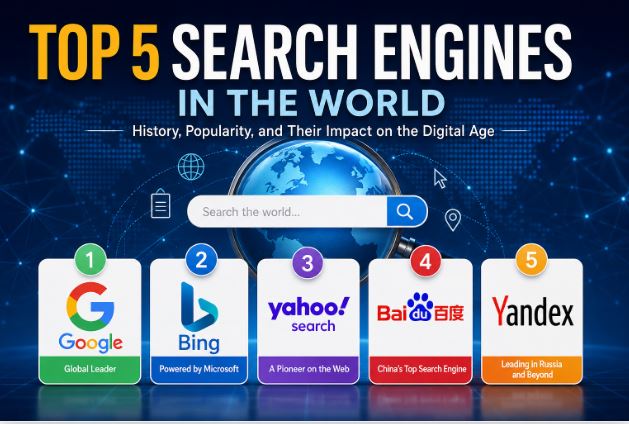
This article analyzes the top five search engines worldwide, with particular attention to their history, popularity, distinctive strengths, and societal impact.
The Evolution of Search Engines
Before the development of search engines, locating information online was challenging. In the early 1990s, websites were manually organized into directories, which made it difficult for users to find relevant content.
With the expansion of As the internet expanded, search engines were created to organize the growing volume of online information.
Early examples such as Archie, AltaVista, Lycos, and Yahoo! helped users navigate the web. Algorithms, artificial intelligence, machine learning, and data processing have transformed search engines into sophisticated tools.
These technologies enable search engines to interpret user intent and deliver highly relevant results. Today, search engines process billions of queries each day and are among the most frequently visited websites worldwide.
1. Google

Background and History
Google was founded in 1998 by two Stanford University students, Larry Page and Sergey Brin.
The founders developed an innovative ranking system called PageRank, which evaluated the importance of webpages based on the number and quality of links pointing to them. This approach significantly improved search accuracy compared to competitors.
Originally a university research project, Google rapidly evolved into the world’s most dominant search engine.
Popularity
Google currently commands the largest share of the global search engine market and processes billions of searches daily.
Its popularity stems from:
* Fast search results
* Highly relevant information
* Advanced AI-powered algorithms
* Voice search capabilities
* Integration with services such as Gmail, Maps, YouTube, and Android
Why Users Prefer Google
Continuous innovation, an intuitive user interface, and advanced search technology have allowed Google to sustain its leadership position for more than two decades.
2. Microsoft Bing

Background and History
Bing was launched by Microsoft in 2009 as a replacement for its earlier search engine, MSN Search. Microsoft developed Bing to compete directly with Google and to offer users an alternative search experience.
Popularity
Bing is the second-largest search engine in many countries and powers search functionality across various Microsoft products.
The search engine has gained increased attention due to its integration with artificial intelligence technologies and AI-powered search features.
Key Features
* Visual search capabilities
* AI-assisted search
* Integration with Windows
* Rewards program for users
* Strong image and video search: Bing increases its market share through continuous innovation and strategic partnerships.
3. Yahoo Search

Background and History
Yahoo was founded in 1994 by Jerry Yang and David Filo.
Before Google became dominant, Yahoo was one of the most popular destinations on the internet. It offered news, email services, directories, and search capabilities.
Although its market share has declined, Yahoo Search remains one of the most recognized search brands worldwide.
Many users continue to use Yahoo for:
* News
* Finance
* Sports
* Email services
* Search
Legacy
Yahoo played a pioneering role in expanding internet accessibility for millions of users in the early years of the web.
4. Baidu

Background and History
Baidu was founded in 2000 by Robin Li and Eric Xu.
The company primarily serves users in China and has become the country’s leading search engine.
Popularity
Because of China’s large population and extensive internet user base, Baidu is among the most visited websites worldwide.
The platform provides:
* Search services
* AI technologies
* Cloud computing
* Digital maps
* Online communities
Strengths
Baidu specializes in Chinese-language search and offers services tailored to the Chinese market.
Baidu’s deep understanding Baidu’s comprehensive understanding of local language and culture significantly contributes to its widespread popularity.
5. Yandex

History
Yandex was founded in 1997 by Arkady Volozh and his partners.
The company developed advanced search technologies specifically designed for the Russian language.
Popularity
Yandex is the leading search engine in Russia and maintains significant usage in several neighboring countries.
Beyond search, Yandex offers:
* Maps
* Email
* Translation services
* Cloud storage
* Ride-hailing services
Competitive Advantage
Yandex’s ability to interpret complex language patterns and regional search behavior has allowed it to remain highly competitive in its primary markets.
The Role of Artificial Intelligence in Search
Modern search engines increasingly rely on artificial intelligence.
AI helps search engines:
* Understand user intent
* Improve search relevance
* Recognize images and speech.
* Detect spam and misinformation.
* Provide personalized recommendations
The emergence of AI-powered tools such as ChatGPT is influencing how users interact with online information. Search engines are evolving from basic information retrieval systems into intelligent assistants capable of addressing complex queries.
Search Engines and Education
Search engines have become essential educational tools.
Students use search engines to:
* Conduct research
* Access learning resources
* Explore scientific topics
* Read news and current events.
* Develop digital literacy skills.
Educators also rely on search engines to locate teaching materials and educational content.
In countries such as Nepal, search engines provide opportunities to expand access to knowledge and promote lifelong learning.
Challenges Facing Search Engines
Despite their benefits, search engines face several challenges:
* Misinformation
* Privacy concerns
* Data security issues
* Search result manipulation
* AI-generated spam content
Technology companies continue to invest in solutions that enhance information quality and foster user trust.
Conclusion
Search engines have fundamentally transformed how individuals access information and engage with the digital world. From Google’s global dominance to Baidu’s leadership in China and Yandex’s prominence in Russia, each search engine serves distinct audiences and requirements.
As artificial intelligence advances, search engines are expected to become more intelligent, personalized, and interactive.
However, critical thinking, digital literacy, and responsible information use will remain essential. For students, educators, writers, journalists, and lifelong learners, search engines represent more than technological tools.
They function as gateways to knowledge, creativity, and opportunity in the digital age. As the internet evolves, search engines are likely to remain among the most influential innovations shaping how individuals learn, communicate, and explore the world.
References
1. Google Company History
2. Microsoft Bing Official Information
3. Yahoo Corporate History
4. Baidu Corporate Information
5. Yandex Company History
6. Internet World Statistics
7. Search Engine Market Share Reports
