

 Dhruba Prasad Ghimire
Introduction
Why Writing Matters More Than Ever
In an age defined by artificial intelligence, digital media, social networks, and instant access to information, the ability to write effectively remains a powerful skill. While literacy traditionally meant reading and writing, modern literacy includes critical thinking, creativity, communication, research, media literacy, and the ability to express ideas clearly and confidently.
Nepal has made significant progress in education and literacy over the past decades. More children attend school, educational opportunities have expanded, and literacy rates continue to improve. Despite these advancements, new challenges and questions about the future persist.
What comes after literacy?
Can students write clearly and creatively?
Can they distinguish facts from misinformation?
Can they communicate ideas effectively?
Can they tell the stories of their communities?
Can they become informed citizens, innovative thinkers, and future leaders?
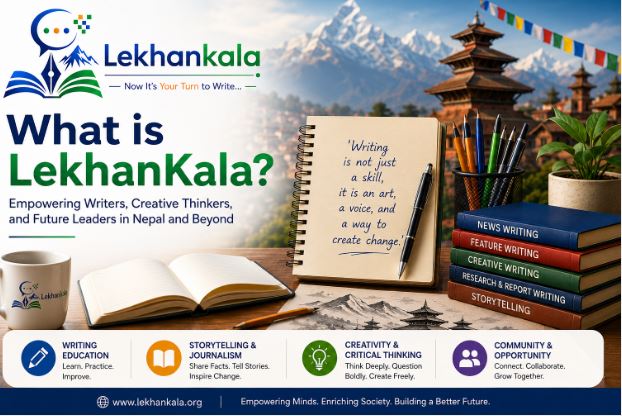
These questions lie at the heart of LekhanKala.org, a platform dedicated to promoting writing, storytelling, journalism, education, creativity, and critical thinking in Nepal and beyond. To better understand LekhanKala’s mission, let us explore its meaning and origin.
What is LekhanKala?
The name LekhanKala combines two meaningful Nepali words:
Lekhan (Writing) and Kala (Art).
Together, they represent a powerful belief: writing is not merely a technical skill—it is an art, a tool for learning, and a pathway to personal and social transformation.
LekhanKala.org is a growing educational and literary platform that helps aspiring writers, students, educators, journalists, researchers, and storytellers learn, practice, publish, and share their ideas with the world.
The platform aims to transform literacy into creativity, curiosity, communication, and critical thinking by providing educational resources, publishing opportunities, and a supportive learning community.
Why LekhanKala Was Created
Many students learn basic reading and writing skills in school, but fewer get guidance on becoming effective writers.
They may understand grammar and vocabulary yet struggle to write:
* News articles
* Feature stories
* Research reports
* Opinion pieces
* Creative stories
* Interviews
* Essays
* Book reviews
Many young people have valuable ideas but may lack confidence or guidance to express them.
LekhanKala was created to bridge this gap.
The platform recognizes that writing develops through learning, practice, feedback, and publication. By providing educational content and publishing opportunities, LekhanKala helps turn readers into writers and learners into communicators.
Writing as a Tool for Learning and Personal Growth
Writing is often viewed simply as a method of communication.
In reality, writing is also a method of thinking.
When individuals write, they must do the following:
* Organize ideas
* Analyze information
* Evaluate evidence
* Reflect on experiences
* Solve problems
* Communicate clearly
This process strengthens cognitive abilities and deepens understanding. Educational research shows that students who write regularly often develop stronger:
* Critical thinking skills
* Communication skills
* Research abilities
* Problem-solving skills
* Self-confidence
In this sense, writing becomes a powerful tool for intellectual and personal development rather than simply an academic requirement.
Teaching the Art of Writing
One of LekhanKala’s distinguishing features is its commitment to teaching writing.
While many platforms focus only on publishing content, LekhanKala emphasizes writing education as the foundation for meaningful communication. It introduces readers to various forms of writing, including:
News Writing
News writing teaches accuracy, objectivity, clarity, and verification. Students learn how to gather facts, identify reliable sources, and report events responsibly.
Feature Writing
Feature writing explores human stories, experiences, and social issues. Writers learn to engage readers emotionally while maintaining factual integrity.
Article Writing
Article writing develops the ability to explain ideas clearly, structure arguments logically, and communicate information effectively.
Report Writing
Report writing requires investigation, organization, analysis, and evidence-based conclusions.
Creative Writing
Creative writing encourages imagination and originality through stories, poetry, personal narratives, and other forms of literary expression.
Research Writing
Research writing teaches students how to gather reliable information, evaluate sources, analyze evidence, and present findings professionally.
Together, these forms of writing help learners develop both creativity and discipline.
Creating Creative Thinkers
Creativity is often misunderstood as limited to art, music, or literature.
In reality, creativity is the ability to generate ideas, solve problems, explore possibilities, and think differently.
Creative thinkers become:
* Entrepreneurs
* Scientists
* Educators
* Engineers
* Designers
* Journalists
* Writers
* Community leaders
Writing is one of the most effective ways to cultivate creativity because it encourages people to imagine, explore, and express.
When students write stories, they create worlds.
When they write essays, they build arguments.
When they write articles, they connect ideas.
When they write poems, they explore emotions.
Each activity strengthens creative thinking and innovation.
Through storytelling and writing education, LekhanKala seeks to nurture a generation of creative thinkers who can contribute meaningfully to Nepal’s future.
Developing Critical Thinkers
If creativity helps people imagine possibilities, critical thinking helps them evaluate those possibilities.
Critical thinking involves:
* Asking questions
* Examining evidence
* Evaluating sources
* Identifying bias
* Making informed decisions
These skills are important in a digital world filled with information, opinions, and misinformation. Students must learn to distinguish between facts and assumptions, between evidence and speculation, and between reliable and unreliable sources. Students must also play a central role in this process.
Good writing requires good thinking.
Before explaining information to others, writers must first understand, analyze, and evaluate it themselves.
For this reason, LekhanKala views writing as a pathway to critical thinking and informed citizenship.
Journalism and Media Literacy in the Digital Age
Modern societies depend on informed citizens.
However, misinformation and disinformation have become significant challenges worldwide.
Media literacy—the ability to access, analyze, evaluate, and create media—has therefore become one of the most important educational priorities of the twenty-first century.
LekhanKala promotes media literacy by encouraging:
* Fact-based reporting
* Ethical journalism
* Source verification
* Responsible communication
* Research-based writing
By introducing young people to journalism and reporting, the platform helps them become both better consumers and creators of information.
Preserving Nepal’s Stories and Cultural Heritage
Every community has stories.
These stories reflect identity, history, values, traditions, and culture.
Yet many local stories disappear because they are never documented.
Nepal is home to extraordinary cultural diversity, languages, traditions, and lived experiences.
From remote Himalayan villages to rapidly growing cities, countless stories remain untold.
LekhanKala encourages writers to document these stories and preserve them for future generations.
In doing so, the platform contributes not only to literature but also to cultural preservation and national identity.
A Platform for Emerging Writers
One of LekhanKala’s most important goals is supporting emerging writers.
Many talented individuals struggle to find opportunities to publish their work and reach wider audiences.
Without platforms for expression, voices and potential remain hidden.
* Ideas remain hidden.
* Potential remains unrealized.
LekhanKala provides a space where students, educators, researchers, youth leaders, journalists, and aspiring writers can share their perspectives and contribute to meaningful conversations.
The platform welcomes content on:
* Education
* Literature
* Technology
* Youth development
* Environment
* Social issues
* Culture
* Community development
* Global affairs
By encouraging participation, LekhanKala helps build confidence and communication skills among future writers and leaders.
Connecting Nepal with Global Opportunities
Writing serves as a bridge between local experiences and global conversations.
Through articles and reports, LekhanKala introduces readers to educational and global opportunities while sharing Nepal’s stories worldwide.
This exchange creates a more connected, informed, and globally engaged society.
Beyond a Website: A Learning Community
LekhanKala is more than a publishing platform.
It is an evolving learning community.
Its vision extends beyond articles and news stories to include:
* Writing education
* Journalism training
* Literary development
* Storytelling initiatives
* Youth engagement
* Educational partnerships
* Community learning
By bringing together writers, readers, educators, journalists, and learners, LekhanKala aims to create an environment where creativity, knowledge, and lifelong learning can flourish.
Looking Toward Nepal’s Future
Nepal’s future will depend not only on economic growth and technological advancement but also on the creativity, communication skills, and critical thinking of its people.
Tomorrow’s leaders must solve complex problems, adapt to rapid change, navigate new technologies, and communicate across cultures and disciplines.
Writing provides a foundation for all these capabilities.
LekhanKala believes that investing in writing is ultimately an investment in people.
It is an investment in creativity.
It is an investment in education.
It is an investment in democracy.
And it is an investment in Nepal’s future.
Frequently Asked Questions (FAQ)
What is LekhanKala?
LekhanKala is a Nepal-based platform that promotes writing, storytelling, journalism, creativity, media literacy, and critical thinking through educational resources and publishing opportunities.
Who can contribute to LekhanKala?
Students, educators, journalists, researchers, youth leaders, and aspiring writers can contribute articles, stories, essays, opinions, and educational content.
Why is writing important?
Writing improves communication, creativity, critical thinking, research skills, and confidence while helping individuals express ideas effectively.
Does LekhanKala teach writing?
Yes. LekhanKala provides resources on news writing, feature writing, article writing, creative writing, journalism, and research writing.
How does LekhanKala support Nepal’s development?
By promoting literacy, creativity, critical thinking, media literacy, and youth engagement, LekhanKala helps develop informed, innovative, and empowered citizens.
Conclusion
LekhanKala is more than a literary platform.
It is a movement dedicated to transforming literacy into creativity, curiosity, critical thinking, and meaningful communication.
Through writing education, storytelling, journalism, and lifelong learning, the platform empowers individuals to share their ideas, document their experiences, and participate actively in society.
In a world increasingly shaped by information and technology, the ability to write thoughtfully may be one of the most valuable skills a person can possess.
By helping people learn not only how to write but also how to think, analyze, create, and communicate, LekhanKala is contributing to the development of a more informed, innovative, and empowered Nepal.
Because every great idea begins with a thought, every thought deserves expression, and every expression has the power to inspire change.
