 Laxman Ghimire
 Aug 10, 2026
Building bridges between South Asian creators and global platforms for human rights, creativity, and social change.
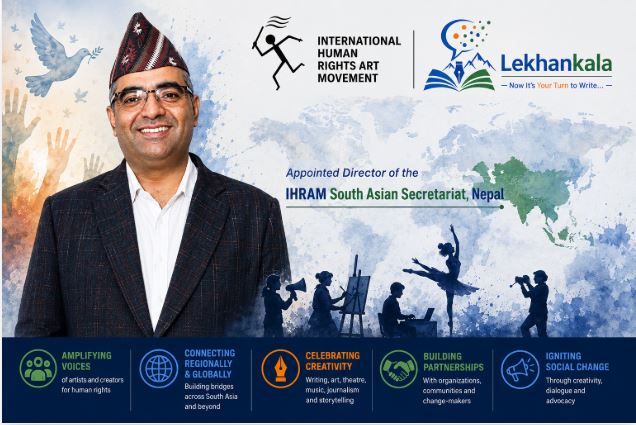
Kathmandu, Nepal — A new chapter is coming to life where arts, creativity, and human rights intersect in South Asia, as Dhruba Prasad Ghimire, Co-Founder and Executive Director of LekhanKala.org, takes on the role of Director for the IHRAM International Secretariat, Nepal.
The International Human Rights Arts Movement (IHRAM) established its South Asian Secretariat in Kathmandu to expand its support for artists, writers, performers and creative activists who use their work to raise awareness of human rights and social justice.
Founded in 2017, IHRAM has developed an international platform connecting creators and human rights defenders through different regions of the world. With offices in multiple countries, the movement highlights artists working within their own communities while creating opportunities for their viewpoints and narratives to reach international audiences.
With the launch of the IHRAM South Asian Secretariat in Nepal, an essential gateway swings open, inviting South Asian creative communities to forge closer connections with the global human rights movement.
Dhruba Prasad Ghimire Appointed IHRAM South Asia Director
As Director of the IHRAM South Asian Secretariat in Nepal, Dhruba Prasad Ghimire aims to unite artists, writers, journalists, youth, and human rights defenders from across South Asia.
In this voluntary role, Ghimire utilizes his expertise, dedication, and broad professional network to advance IHRAM’s mission and foster enhanced regional unity. He is guided by the belief that meaningful social change begins with individuals who contribute their knowledge, energy, and time for the collective good.
In collaboration with IHRAM’s headquarters in New York, Ghimire and the Nepal Secretariat will prioritize the following objectives:
• Identifying and amplifying artists and creators using creativity to address human rights and social justice issues.
• Developing regional programs and creative initiatives connecting artists and activists across South Asia.
• Creating international opportunities for South Asian writers, artists, performers and storytellers to share their work with worldwide audiences.
• Presenting the experiences of human rights defenders and the challenges they face in their communities.
• Producing interviews, stories, creative features and public programming that bring human rights issues into wider conversation.
• Building partnerships with civil society organizations, cultural institutions, artists, journalists, educators and youth-led organizations.
• Connecting South Asian creators with international networks of artists and human rights defenders.
• Supporting emerging voices, particularly emerging creators, who use writing, storytelling, journalism and other forms of creative expression to promote positive social change.
By these efforts, the Secretariat seeks to create a lasting platform in which creativity becomes a trigger for dialogue, awareness, and advocacy.
A Regional Platform for South Asian Creators
From its home in Kathmandu, the Secretariat will connect with creators across Nepal, India, Pakistan, Bangladesh, Sri Lanka, Bhutan, Maldives, and Afghanistan, opening doors for their stories and creative expressions to flow into the global conversation on human rights.
South Asia’s deep heritage of literature, poetry, visual arts, theatre, journalism, music, and storytelling pulses with creativity. Yet, artists and creative communities here courageously face urgent issues such as inequality, discrimination, violence, freedom of expression, women’s rights, corruption, and social justice.
The IHRAM South Asian Secretariat strives to carve out space for these essential conversations, letting art and creative expression speak for itself.
IHRAM views creativity not simply as entertainment, but as a strong tool to document lived experiences, confront injustice, nurture empathy, and ignite social change.
Connecting Local Voices with the World
A core mission of the Secretariat will be to link creators based in their local communities with kindred writers, performers, artists, and human rights defenders around the world.
Through collaboration alongside thought leaders and creative communities in Nepal, India, Pakistan, Bangladesh, Sri Lanka, Bhutan, Maldives, and Afghanistan, as well as with IHRAM’s international network, the Secretariat will seek to build bridges between local experiences and global conversations.
The initiative will ignite creative programming, interviews, storytelling projects, exhibitions, literary activities, digital campaigns, and more, offering artists new ways to share human rights issues in engaging and user-friendly forms.
Creativity as a Human Right
IHRAM’s work is based on the belief that artists should be free to use their creativity to contribute to social change and that creative expression itself is an important dimension of human rights.
The movement works to raise the voices of artists and creators who bring difficult human rights issues to the forefront of public discussion.
These issues may include corruption, police brutality, violence against women, discrimination, inequality, restrictions on freedom of expression, and government indifference toward citizens’ rights.
By building creative platforms and enduring international connections, IHRAM is committed to ensuring these stories are heard and never forgotten.
LekhanKala and a New International Responsibility
For LekhanKala.org, this role is an opportunity to intertwine its work in writing, storytelling, journalism, media literacy, and youth empowerment into the network of a wider international movement for human rights and social justice.
Under Ghimire’s guidance, LekhanKala has been supporting a culture of writing and creative expression among Nepal’s children and youth.
Its collaborations with students, schools, writing clubs, and emerging creators form a firm foundation for bringing fresh voices into conversations about human rights, citizenship, and social change.
This new responsibility at IHRAM unlocks another channel for these creative communities to connect with artists and advocates far beyond Nepal’s borders.
It also creates opportunities for young South Asian writers and storytellers to step beyond local platforms and join international conversations through their creativity.
Building the Future Through Collaboration
Collaboration will be the core of the IHRAM South Asian Secretariat. Its upcoming work will bring together artists, writers, journalists, educators, civil society organizations, youth networks, cultural institutions, and human rights defenders under one creative roof, showcasing artistic work and forging meaningful bonds between creativity and social action.
Through interviews, profiles, creative publications, joint projects, regional programs, and international exchanges, the Secretariat aims to ensure that artists and their stories remain at the center of conversations about human rights.
Vision:
We believe in a world where artists are free to use their creativity to
drive social change, and their work is honored as a human right.
Mission:
We amplify the critical voices of artists who risk their lives to bring
human rights issues to the forefront of conversation and inspire social
change around the world.
Values:
Beauty as a fundamental creative value; sincerity and vulnerability of
presentation; opening doorways of engagement and celebrating diversity!
A New Platform for South Asian Voices
By anchoring its Secretariat in Kathmandu, IHRAM is transforming Nepal into an energetic crossroads for South Asian creative communities and the international human rights arts movement. This is a chance to help forge international pathways for the voices of South Asian artists, writers, journalists, and young storytellers whose work can oppose injustice, ignite dialogue, and motivate change.
As the Secretariat launches its regional programming, its message resounds: when artists are free to share their stories, creativity transforms into a powerful force for human rights and social justice.
Other Related News