Lekhan Kala
 Jun 3, 2026
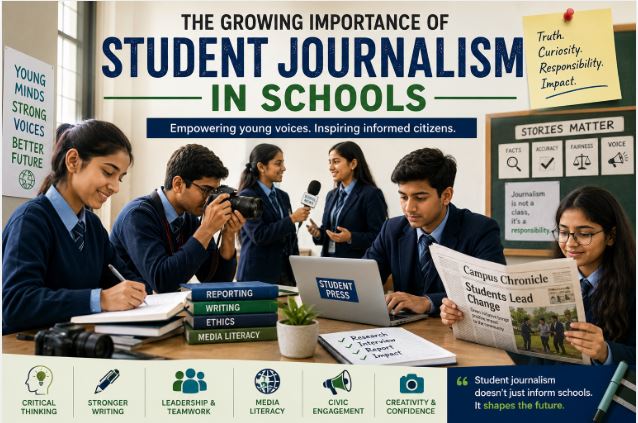
Empowering Young Voices through Reporting, Storytelling, and Critical Thinking
Kathmandu, Nepal – Schools are adopting innovative approaches to prepare students for a complex, information-driven world.
Student journalism is emerging as a powerful educational tool that fosters critical thinking, communication skills, media literacy, and civic engagement.
Young journalists are increasingly taking active roles in reporting stories relevant to their peers and communities through school newspapers, digital magazines, podcasts, and student-led news platforms.
Educators maintain that these opportunities enhance academic learning and support the development of informed, responsible, and engaged citizens.
Student journalism provides young people with a platform to express their ideas, investigate issues, and share stories that might otherwise remain unrecognized.
Through reporting and storytelling, students develop skills in inquiry, information gathering, and effective communication with diverse audiences.
Many schools have established student newspapers, newsletters, blogs, and media clubs to promote active participation in school life.
These initiatives enable students to cover events, interview teachers and community leaders, examine social issues, and highlight achievements within their schools.
“Student journalism empowers young people to become active participants rather than passive consumers of information,” stated an education advocate. “It helps them understand the value of responsible communication and informed dialogue.”
Developing Critical Thinking Skills
A primary benefit of student journalism is its capacity to cultivate critical thinking. Student journalists must evaluate information, verify facts, analyze multiple perspectives, and present balanced viewpoints.
In an era marked by the rapid spread of misinformation and disinformation through digital platforms, these skills are increasingly essential.
Students engaged in journalism learn to distinguish credible sources from unreliable ones, assess evidence, and make informed judgments based on facts rather than assumptions.
These competencies contribute to academic achievement, lifelong learning, and responsible citizenship.
Strengthening Communication and Writing
Writing is one of the most valuable skills in both educational and professional contexts. Student journalism provides practical opportunities for learners to improve their writing, editing, interviewing, and public speaking abilities.
By composing news reports, feature articles, opinion pieces, and multimedia content, students gain practical experience in organizing information, presenting arguments, and engaging audiences.
Teachers frequently observe significant improvements in students’ confidence, creativity, and communication skills following participation in journalism activities.
Building Media Literacy in the Digital Age
Students today encounter an unprecedented volume of information through social media, websites, and digital platforms.
Understanding how media is created, distributed, and consumed is essential for responsible navigation of this environment.
Student journalism serves as a valuable tool for media literacy education by enabling learners to understand journalistic standards, ethical reporting practices, source verification, and the importance of accuracy.
By producing content, students gain insight into the production of the media they encounter daily and develop a more critical approach to it.
Encouraging Leadership and Civic Engagement
Beyond reporting and writing, student journalism fosters leadership, teamwork, and community involvement. Student journalists often collaborate on projects, manage editorial responsibilities, and address issues affecting their schools and communities.
These experiences cultivate initiative, responsibility, and problem-solving skills, while encouraging students to participate actively in civic life.
Through journalism, young people recognize that their voices contribute to meaningful discourse and positive social change.
Challenges and Opportunities
Although student journalism offers numerous benefits, schools often face challenges such as limited resources, insufficient training, and restricted access to publishing platforms.
Advances in digital technology, however, have created new opportunities for students to produce and disseminate content through websites, blogs, podcasts, and videos.
Educational organizations and literacy advocates increasingly encourage schools to invest in journalism programs to prepare students for the demands of the twenty-first century.
The Future of Student Journalism
As societies navigate rapid technological and social change, the importance of critical thinking, ethical communication, and media literacy will continue to increase.
Student journalism provides a unique opportunity to develop essential competencies while fostering creativity, curiosity, and civic responsibility.
By encouraging students to investigate, question, and communicate, schools can nurture a generation of informed and engaged citizens.
Student journalism is more than an extracurricular activity; it is an educational practice that empowers young people to understand the world around them and contribute meaningfully to it.
Why Student Journalism Matters
Develops critical thinking and analytical skills
Improves writing and communication abilities
Promotes media and information literacy
Encourages civic engagement and leadership
Strengthens research and fact-checking skills
Builds confidence and creativity
Empowers students to share their perspectives
Supports responsible digital citizenship
As education evolves to address the challenges of the modern world, student journalism demonstrates its value as a powerful tool for learning, engagement, and empowerment.
Young people are not only the future of journalism; they are actively shaping discourse today through their curiosity, creativity, and commitment to truth.
“When students learn to tell stories, they learn to understand the world—and their place within it.”
Other Related News